Translating a fluid, colour-saturated photographic reference onto a flat, two-dimensional piece of archival paper requires an intense shift in preception. The camera lens captures light across a spectrum of colour frequencues; traditional monochrome art demands that the artist dicard colour entirely and calculate form strictly through the physics of carbon density.
Before a singular mark of the charcoal stick touches the paper tooth, the studio exectes a precise digital contrast-mapping prorocol. This mechanical stage is what engineers the deep shadow baselines and crisp highlights necessary to command spatial authority in the physical drawing.

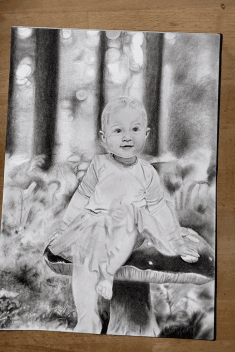
I. The Dynamic Range Equation Correcting the Camera’s Flaws
Standard digital cameras are engineered to compress highlights and shadows to create an evenly lit, commercially safe image. For the fine art monochrome draftsman, this compression is highly problematic because it flattens the deep values and mutes the extreme contrasts.
To prep a scene for physical drafting, the studio systematically alter the digital master file through two rigorous parameters:
- Shadow Exposure Saturation: The darker areas of the image are deliberately pushed down to establish absolute black coordinates. This maps out the exact placement where dense, compressed mineral carbon must be driven into the paper fibers to create a light-absorbing velvet abyss.
- Highlight Extraction: Mid-tone colour values are mechanically isolated and hightened to identify where the paper tooth must remain entirely untouched by charcoal dust, ensuring the final artwork catches ambient gallery light flawlessly.
II. Structural Geometry Preservation
Altering contrast digitally is merely a precursor to the physical reality of the steady hand at the easel. It allows the studio to trace the hard structural boundaries of complex historic landmarks, architectural lines, or fine wildlife details before execution begins.
By calculating these tonal parameters in advance, the artist eliminates all hesitation during the drawing phase. The digital map acts as an unyielding blueprint, allowing the sharp compressed charcoal and rulers to lock down structural elements in total, silent stillness.
III. The Asset Value of Technical Preparation
For the dedicated collector, understanding this digital-to-physical value mapping reveals the deep calculated discipline behind every original work. The artwork is not a casual reproduction of a random photograph; it is an engineered study in light manipulation and carbon permanence, build to command attention across any gallery or residential space.
Contextual Records:
- Tonal Execution: See this dynamic range mapping out fully realized across complex civil architecture in Monograph: Contrast Dynamics in ‘Retford Market Poppies’
- Tonal Execution (Theory): Explore the deeper academic principles of form conversion and geometric drafting in Technical Paper: The Geometry of Perception and Spatial Mechanics in Drawing.
The Carbon Folio Registry
The studio’s technical mapping files, original monographs, and seasonal print releases are archived exclusively for registered collectors.