
The act of traditional drafting is frequently misunderstood as a simple, instinctual creative impulse. In reality, translating a three-dimensional environment onto a two-dimensional plane requires a rigorous, calculated understanding of structural geometry and value dynamics.
Before raw charcoal can be applied to the paper, the artist must master the mechanics of optical measurement, spatial scaling, and the deliberate conversion of light into absolute tonal form.
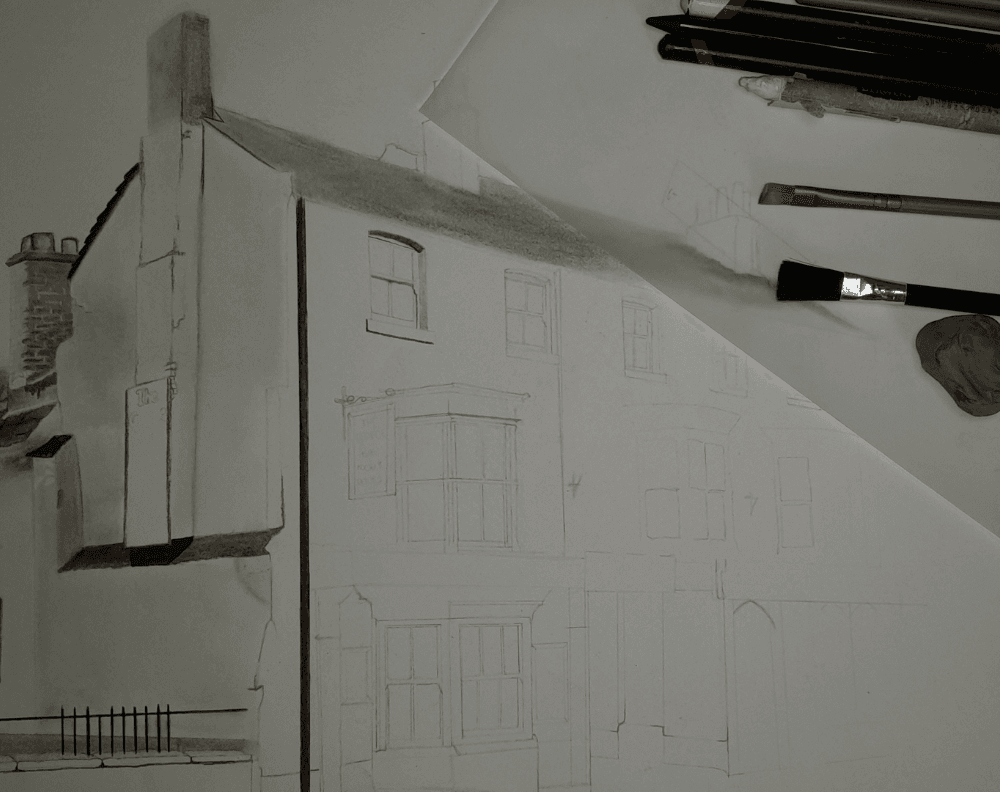
I. The Principles of Observational Geometry
To capture a subject with uncompromising accuracy, the eye must reject superficial details and look directly for underlying geometric mass. Every complex form-whether it is a historic architectural landmark or an organic wildlife structure-is built upon a foundation of basic three-dimensional shapes.
- Structural Deconstruction: The initial lines on the paper must focus entirely on isolating boundaries, planes, and proportional relationships. This mechanical approach establishes the exact architectural foundation of the composition before any shading or blending can occur.
- The Discipline of the Steady Hand: Perfect alignment cannot be rushed. It requires an absolute mastery of hand-eye coordination to construct clean, unyielding geometric boundaries that ensure the final artwork possesses immense structural weight.
II. The Conversion of Light into Value Scales
Once the geometric boundaries are locked into place, the artist must transition from analyzing form to calculating value. Traditional monochrome drafting explicitly rejects the distraction of colour, forcing the viewer to look entirely at the interplay of light and deep shadow.
- The Scale of Contrast: The artist maps out a rigid value scale, ranfing from the absolute white of the untouched archival cotton rag to the deepest, light-absorbing carbon blacks.
- Subtractive Allocation: Through a slow, calculated process of layering and precise erasure, mid-tones are established and highlights are carved out. This disciplined value placement is what prevents a complex drawing from collapsing into a flat fields of grey, ensuring the piece commands visual authority across a room.
III. The Collector’s Perspective on Technical Mastery
For the dedicated art investor, understanding these underlying spatial mechanics reveals the true value of a fine art acquisition. A finished charcoal drawing is not merely a collection of decorative marks; it is the culmination of hundreds of hours of intense visual calculation and absolute technical control.
Contextual Records:
- Tonal Execution: Observe these geometric and value principles applied to complex architectural drafting in Monograph: Contrast Dynamics in ‘ Retford Market Poppies’.
- The Archival Standard: Explore how high-contrast value maps create a powerful visual focus in modern residential spaces in Technical Paper: Spatial Anchoring of Monochrome Media in Modern Architecture.
The Carbon Folio Registry
The studio’s research papers, structural monographs, and seasonal print releases are catalogued exclusively for registered fine art collectors.